Table of Contents >> Show >> Hide
- Why Traditional Van Planning Gets Messy Fast
- What 3D Scanning Brings to an Off-Grid Van Build
- Smarter Planning Means Smarter Off-Grid Systems
- How a Scan-First Workflow Usually Looks
- The Biggest Mistakes 3D Scanning Helps Avoid
- Why This Matters More for Off-Grid Travel Than Weekend Camping
- Real-World Experience: What a Scan-First Van Build Feels Like
- Conclusion
Building an off-grid camper van used to begin with a tape measure, a notepad, and a brave amount of optimism. You would crawl inside a cargo van, measure one wall, measure the opposite wall, realize they were mysteriously different, then stare at the curved metal shell as if it had personally betrayed you. That is exactly why 3D scanning has become such a smart planning tool for modern van conversions.
Instead of guessing where cabinets, wiring runs, insulation, water tanks, and battery boxes might fit, builders can now create a digital model of the van before cutting a single sheet of plywood. That changes everything. In an off-grid van build, every inch matters, every pound matters, and every mistake costs money, time, or both. A 3D scan turns a weirdly curved steel cave into a workable design file, which means better layout decisions, fewer surprises, and a much smoother path from empty cargo shell to rolling tiny home.
And let’s be honest: “measure twice, cut once” sounds wise until you’re working inside a van that appears to have been designed by a committee of bananas. Smarter planning is not just convenient here. It is survival.
Why Traditional Van Planning Gets Messy Fast
An empty cargo van looks simple from the outside, but the interior is full of headaches. The walls curve. The ceiling ribs interrupt clean lines. Wheel wells steal floor space. Door frames flare in odd ways. Factory mounting points are useful, but they are not always where you wish they would be. If you are building for off-grid travel, you also need to fit major systems into this puzzle: a bed platform, storage, a galley, electrical components, water storage, ventilation, insulation, and maybe even a workspace or shower.
This is where many DIY builds start leaking time. Builders sketch layouts on graph paper or in simple design apps, then realize the actual van shell does not match the fantasy. A cabinet that looked perfect in a flat drawing may interfere with a body rib. A water tank may fit on paper but block plumbing access. A bed may be wide enough in the middle of the van but too wide near the wall curvature. Suddenly, the “simple weekend project” develops a dramatic personality.
For off-grid use, sloppy planning creates bigger problems than an ugly cabinet line. Bad layout choices can reduce battery access, make maintenance miserable, compromise ventilation, overload one side of the van, or waste precious storage. In a rig built to live away from hookups, design mistakes do not stay in the garage. They come with you into the desert, the forest, and the grocery store parking lot where you pretend this is all very glamorous.
What 3D Scanning Brings to an Off-Grid Van Build
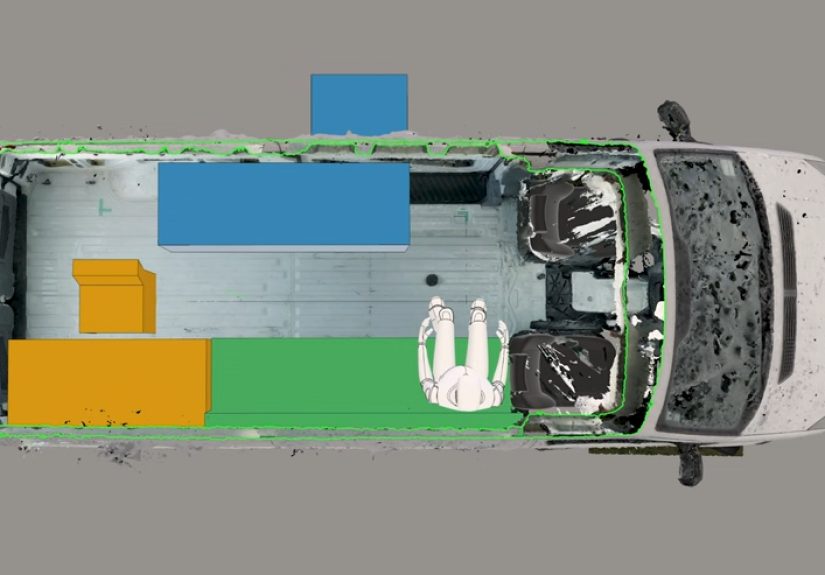
3D scanning changes the planning phase from rough approximation to digital reality. The builder scans the van interior, and sometimes the exterior too, creating a model that can be imported into CAD or design software. That model becomes a reliable reference for walls, curves, openings, ribs, and irregular surfaces. Instead of designing around assumptions, you design around the actual van.
This is a big deal because a van is not a rectangular room. It is more like a metal backpack with windows. Once you have a scan, you can test layout ideas with far more confidence. You can check whether overhead cabinets will clear your head, whether a bench seat blocks a door track, or whether a battery compartment still leaves room for airflow and service access.
Photogrammetry vs. LiDAR
There are a few ways builders create these digital models. One method is photogrammetry, which uses overlapping photos and software to reconstruct a 3D shape. It is often more affordable because it can be done with a regular camera or phone. Another option is LiDAR-based scanning, which captures spatial data more directly and is often better when dimensional precision is the top priority.
For many van builders, the best choice depends on budget, tools, and accuracy needs. A DIY builder might start with photogrammetry to map the van shell and then confirm critical dimensions manually. A pro shop or detail-obsessed builder may prefer LiDAR because it is faster to trust when you are designing tight cabinetry, CNC-cut wall panels, or modular furniture that needs to fit with very little adjustment.
The real win is not the buzzword. It is the workflow. A digital scan lets you stop treating the van like an abstract sketch and start treating it like a precise design environment.
Smarter Planning Means Smarter Off-Grid Systems
People hear “3D scan” and think about pretty renderings, but the smartest part is how it improves systems planning. Off-grid van builds are not just interior decorating projects with more sawdust. They are compact utility systems on wheels.
1. Electrical Layout Gets More Rational
Off-grid power is the heart of the build. If you plan to work remotely, run a fridge, charge cameras, use induction cooking, or power a vent fan all day, your electrical system needs careful sizing. A scan helps you find real placement options for batteries, inverters, fuse blocks, solar controllers, and cable runs before you start drilling holes and committing to permanent structure.
That matters because solar alone is rarely magic. Solar panels help extend your time off-grid, but they do not produce equally all day, and they definitely do not work at night. A thoughtful builder uses the digital model to balance roof space, interior storage, service access, and backup charging options like alternator charging or shore power. In other words, the scan helps turn “I want solar” into “Here is exactly where the components go, how they fit, and how I’ll reach them when something needs service.”
2. Water Storage and Plumbing Stop Being Guesswork
Water tanks are bulky, heavy, and rude about stealing space. Gray water tanks can be even ruder. When a builder uses a scanned model, it becomes easier to fit tanks under benches, over wheel wells, or near the center of the van where weight distribution works better. You can also plan where plumbing lines and vents will run, where a pump can be mounted, and whether winterizing access will be simple or a future act of revenge against yourself.
In a good off-grid layout, fresh water, electrical storage, and daily-use items are placed intentionally rather than shoved wherever they happen to fit. That intention usually starts long before construction. It starts in the model.
3. Insulation, Ventilation, and Condensation Control Improve
Condensation is one of the least glamorous parts of van life, which is impressive in a lifestyle that already includes public restrooms and parking-lot oatmeal. Warm, moist air in a tight space will find cold surfaces and create trouble. With a scan, builders can plan where wall cavities are deepest, where insulation layers need special attention, and where ventilation components should go for better airflow.
That helps with fan placement, upper cabinet spacing, wall panel fitment, and access around windows and doors. It also reduces the temptation to overbuild decorative features that trap moisture or block airflow. In a van, pretty and practical need to be on speaking terms.
4. Weight Distribution Becomes Easier to Manage
Every off-grid dream eventually meets physics. Batteries, water, cabinetry, tools, appliances, and recovery gear add up quickly. Planning from a 3D model helps builders visualize where heavy components sit relative to each other and to the axle load. That does not replace actual weighing and payload calculations, but it helps prevent the classic DIY move of building a rolling apartment on one side of the van and a hallway on the other.
Smarter planning means keeping big loads low, accessible, and sensibly distributed. It is much easier to do that in the design phase than after the cabinets are bolted in and your suspension starts writing complaint letters.
How a Scan-First Workflow Usually Looks
A smart van conversion workflow usually follows a few simple stages.
Capture the Space
The builder scans the van interior using photogrammetry, LiDAR, or a dedicated 3D scanning setup. The goal is to capture the shell, door openings, wheel wells, ceiling ribs, and any geometry that affects layout.
Clean Up the Model
The raw file is cleaned up in software, removing noise and preparing the model for design use. Some builders only need a rough shell. Others create a detailed, dimensionally useful reference for cabinetry, wall panels, and CNC parts.
Design Around Real Constraints
Now the fun begins. The builder places furniture, appliances, tanks, and electrical components inside the digital van. This is where smarter planning shines. You can test multiple layouts without wasting materials. Bed east-west or north-south? Fixed bed or convertible dinette? Big kitchen or bigger garage storage? The model lets you experiment before your bank account gets involved.
Check Maintenance Access
One of the smartest uses of 3D planning is not design flair. It is maintenance access. Can you reach the water pump? Can you inspect the electrical system? Can you remove a battery without dismantling half the van? Great builds are not just beautiful on delivery day. They are serviceable two years later.
Build With Fewer Surprises
Once the layout is finalized, the scan-informed design can guide fabrication. Builders can template wall panels more accurately, design cabinetry to match the shell, and reduce the amount of awkward trimming on install day. Less rework means less waste, faster progress, and far fewer moments of standing in the driveway whispering, “That should have fit.”
The Biggest Mistakes 3D Scanning Helps Avoid
The first mistake is assuming the van is symmetrical. It usually is not. The second is overestimating what solar can do without proper battery storage and backup charging. The third is forgetting maintenance access. The fourth is building beautiful furniture that makes the van harder to live in. The fifth is ignoring weight until the build is almost finished.
3D scanning does not make anyone immune to bad ideas, but it does make bad ideas easier to spot early. A smart digital model reveals clearance problems, weird pinch points, inefficient storage zones, and component clashes before they become expensive reality. It also helps builders communicate with fabricators, electricians, and partners who may otherwise only understand the project after the fifth frustrated explanation.
Why This Matters More for Off-Grid Travel Than Weekend Camping
A casual camper can get away with a few compromises. An off-grid van usually cannot. When the vehicle is expected to support longer stays away from hookups, it needs better energy planning, more thoughtful storage, and a layout that supports real daily life. That means power resilience, water efficiency, airflow, and comfort all need to work together.
3D scanning supports that level of planning because it encourages systems thinking. The bed is not just a bed. It may also define garage storage, electrical access, and tank placement. The galley is not just a kitchen. It may control water routing, ventilation, and walking space. The roof is not just where solar goes. It may also need room for a fan, rack, awning, and future upgrades.
When you see the whole van as a digital system, you design the whole van as a digital system. That mindset is what separates many polished off-grid builds from the charming but chaotic ones.
Real-World Experience: What a Scan-First Van Build Feels Like
Builders who use 3D scanning often describe the experience less as “fancy tech” and more as “finally getting the van to stop lying to them.” That sounds dramatic, but it makes sense. Before scanning, many people believe they understand the interior after a few measurements. Then construction starts, and the shell reveals all its little surprises: a wall that leans more than expected, a rib that lands exactly where a cabinet side needs to go, a door cutout that steals the corner you were counting on, or a wheel well that ruins a storage box you already cut. A scan does not remove every problem, but it changes the emotional rhythm of the project. Instead of discovering issues with a circular saw in your hand, you discover them on a screen while drinking coffee.
That shift matters more than it sounds. DIY van conversions can become mentally exhausting because every change ripples into three more changes. Move the water tank and you may need to move plumbing. Move plumbing and you may need to adjust cabinet depth. Adjust cabinet depth and suddenly your bed length changes. Scan-first builders usually report a calmer process because they can test these domino effects early. The project becomes less reactive and more deliberate.
There is also a confidence boost that comes from seeing the van digitally before building it physically. Even experienced fabricators appreciate being able to rotate the model, zoom in on awkward areas, and verify how panels or furniture will meet curved surfaces. For first-time builders, that confidence can be even more valuable. Van builds involve a lot of irreversible decisions. Once you drill, cut, glue, or bolt parts into place, the van starts keeping score. A scan makes the early decisions feel less like gambling and more like engineering.
Another common experience is that scanning encourages restraint. That might be the most underrated benefit of all. When people first imagine van life, they often want everything: a huge bed, a full kitchen, a giant battery bank, a wet bath, a standing desk, a hidden gear garage, and enough storage to survive a minor apocalypse. Then the scan shows the actual space. The van gently says, “That is adorable, but no.” Surprisingly, this can improve the final build. Once builders see real constraints, they stop designing for fantasy and start designing for use. The result is often simpler, lighter, and more livable.
Scan-first planning also helps when the build evolves over time. Many off-grid vans are not truly “finished.” Owners add another solar panel, upgrade batteries, swap a fridge, change the bed platform, or rework storage after months on the road. A digital model makes those revisions easier because the van already exists as a reference. Instead of starting over with fresh measurements, you return to the model, test changes, and build the next upgrade with fewer surprises.
Perhaps the biggest real-world lesson is this: 3D scanning does not build the van for you. It will not choose the perfect floor plan, keep your budget under control, or stop you from buying hardware at the store three separate times in one day. But it does create clarity, and clarity is gold in a project where space is tight, systems overlap, and mistakes are expensive. For an off-grid van build, smarter planning is not about making the process look futuristic. It is about making the build more accurate, more efficient, and a whole lot less painful.
Conclusion
“Off-grid van build uses 3D scanning for smarter planning” is more than a catchy headline. It reflects a real shift in how serious builders approach van conversions. By capturing the van as it truly exists, not as they wish it existed, they can design better layouts, reduce waste, improve off-grid performance, and avoid many of the mistakes that slow down DIY projects.
Whether the tool is photogrammetry, LiDAR, or another digital scanning method, the principle is the same: better data leads to better decisions. In a space where inches matter, power matters, moisture matters, and access matters, that advantage is enormous. The result is not just a nicer-looking van. It is a more functional, more reliable, more livable off-grid home on wheels.
And that is the dream, isn’t it? Not simply building a van that looks good in photos, but building one that works beautifully when the outlets disappear, the weather changes, and the road keeps going.