
Table of Contents >> Show >> Hide
- What Is a Narcolepsy Service Dog (and What It’s Not)?
- How Can a Narcolepsy Service Dog Help?
- Do You “Qualify” for a Narcolepsy Service Dog?
- Finding a Narcolepsy Service Dog: Your Real Options
- Choosing the Right Dog: Temperament Beats “The Perfect Breed”
- Training a Narcolepsy Service Dog: A Practical Roadmap
- Your Rights in Housing, Work, and Travel (U.S. Snapshot)
- How to Avoid Scams and “Instagram Certifications”
- Frequently Asked Questions
- Real-World Experiences: What Life With a Narcolepsy Service Dog Can Feel Like (About )
- Conclusion: Building the Right Team (Not Just Getting a Dog)
Narcolepsy has a talent for picking the least convenient moments to show upmid-meeting, mid-meal, mid-“I swear I’m listening.” If you live with excessive daytime sleepiness, sudden sleep attacks, sleep paralysis, hallucinations at sleep-wake edges, and (for some) cataplexy, you already know this isn’t “just being tired.” It’s a neurological sleep-wake disorder that can affect safety, independence, and confidence.
A narcolepsy service dog can’t cure narcolepsy (if only), but the right dogproperly trainedcan add a practical safety net: nudging you before a sleep attack, guiding you to a safe seat, retrieving meds, interrupting automatic behaviors, or getting help if you’re injured. And yes, the dog may also provide emotional comfort… but under U.S. law, comfort alone isn’t what makes a dog a service animal. The magic is in the trained tasks.
This guide walks you through what narcolepsy service dogs can do, how people typically qualify through programs, how to find an ethical trainer or organization, what training actually looks like (spoiler: it’s more “tiny reps every day” than “one dramatic boot camp”), and the practical realities: cost, waitlists, public access, travel, and the scammy corners of the internet you should avoid.
What Is a Narcolepsy Service Dog (and What It’s Not)?
Service dog vs. emotional support animal (ESA)
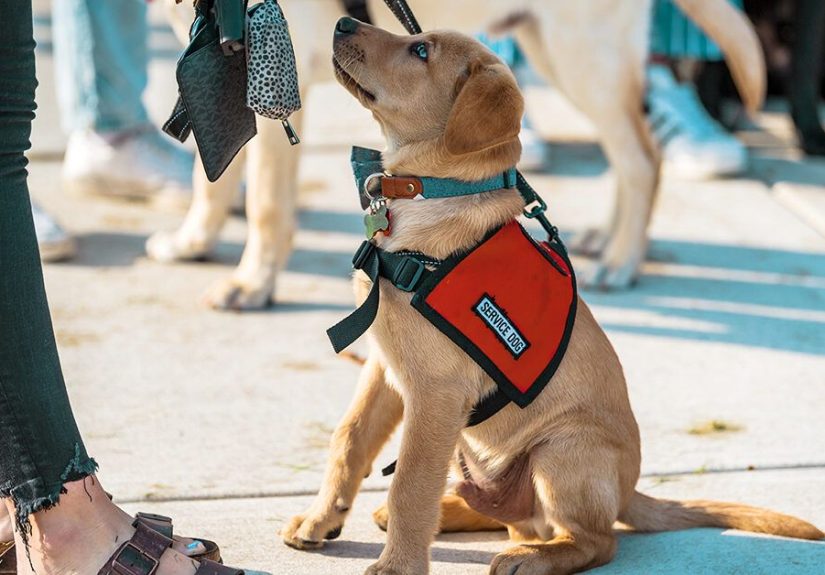
Under the Americans with Disabilities Act (ADA), a service animal is a dog that’s individually trained to do work or perform tasks directly related to a person’s disability. An ESA may provide comfort by presence, but ESAs are not the same as ADA service animals.
The ADA “two questions” rule (your script for awkward moments)
In most public places, staff can ask only two questions when it isn’t obvious what your dog does: (1) Is the dog a service animal required because of a disability? and (2) What work or task has the dog been trained to perform? They can’t demand documentation, require the dog to demonstrate tasks, or ask about your diagnosis.
Translation: you don’t need an “official certificate,” a vest, or a badge to be legit. But you do need a dog that is actually trained, under control, and behaving appropriately in publicbecause the world has enough chaos already.
How Can a Narcolepsy Service Dog Help?
Narcolepsy symptoms and severity vary widely. Some people deal mostly with crushing daytime sleepiness and “sleep attacks,” while others also experience cataplexy (sudden muscle weakness often triggered by strong emotions), sleep paralysis, vivid hallucinations, and fragmented nighttime sleep. Your dog’s task list should match your pattern, triggers, and risks.
Common task categories for narcolepsy
- Sleep-attack interruption or pre-episode alert: Some handlers train dogs to nudge, paw, or “boop” before or during an oncoming sleep episode, giving time to sit, lie down, move away from stairs, or set a phone alarm. Important reality check: reliable “alerting” isn’t guaranteed for every dog/handler pair; many dogs learn to respond to observable cues (posture changes, head-bobbing, slowed responses) rather than detecting a mysterious internal signal.
- Cataplexy support: If you experience cataplexy, tasks may include “brace” (only when appropriately sized and professionally trained), guiding to a safe position, fetching help, or bringing a phone. Cataplexy can be triggered by emotions like laughter or surprise, so “get me safe fast” is often the goal.
- Post-episode assistance: Waking you with persistent nudges, bringing medication/water, retrieving items you dropped, or helping you re-orient after a sleep episode.
- Automatic behavior interruption: Some people with narcolepsy experience automatic behaviors during microsleeps (doing things without full awareness and later not remembering). A dog can be trained to interrupt repetitive behaviors (like fidgeting, skin picking, or phone-scrolling into the void) with a nudge that snaps you back to attention.
- Medication and routine support: Trained reminders (bringing a med pouch at set times), retrieving an emergency kit, or guiding you to a designated rest spot.
- Safety buffering: “Block” (standing behind you in lines), creating space when you feel unstable, or guiding you away from hazards like curbs and platform edges. (Yes, your dog can be a fluffy bouncer with manners.)
A concrete example task plan
Let’s say your biggest risk is dozing while cooking or standing on public transit. A practical plan might be: (1) dog notices early cues and performs a trained “nudge + sit cue,” (2) you sit or move to a safe spot, (3) dog retrieves your phone pouch, (4) if you don’t respond, dog performs “get help” (alert a designated person, or press a dog-safe button). The point isn’t a superhero dogit’s a repeatable safety routine.
Do You “Qualify” for a Narcolepsy Service Dog?
Two different “qualification” systems tend to get mixed together:
- Legal qualification under the ADA: you must have a disability and a dog trained to perform disability-related tasks. The ADA does not require special certification or registration.
- Program qualification: organizations often require documentation, interviews, and proof that a service dog is a good fit for your needs, environment, and ability to care for the dog. This isn’t “the law,” it’s the program ensuring a safe match.
What programs commonly look for
- Evidence of diagnosis and functional impact (often from a clinician or sleep specialist).
- Clear safety needs (falls, injuries, dangerous sleep attacks, severe cataplexy, etc.).
- A stable routine and ability to handle daily care, training practice, grooming, and vet needs.
- A safe home environment for a working dog (space, landlord policies, family agreement).
- Realistic expectations (a service dog is help, not a cure, and not a “set it and forget it” gadget).
If you’re early in diagnosis, it’s also useful to understand how clinicians diagnose narcolepsyoften involving overnight sleep testing and a multiple sleep latency test (MSLT). You don’t need to become your own sleep lab, but knowing the basics helps you communicate needs clearly when applying to programs.
Finding a Narcolepsy Service Dog: Your Real Options
Option 1: Apply to a reputable nonprofit or accredited program
Many people start here because the dog is purpose-bred, temperament-screened, and trained through a structured process. Some nonprofits provide dogs and follow-up support at no charge to the client, relying on donations (though you’ll still pay ongoing care costs like food and routine veterinary expenses).
Pros: professional training pipeline, support team, established standards. Cons: waitlists, limited geography, and they may prioritize certain disability categories.
Option 2: Work with a professional trainer (private or small program)
This route can be flexibleespecially if you need custom tasks. But vet your trainer like you’re hiring someone to babysit your future independence (because you are). Look for proven public-access outcomes, transparent methods, and a contract outlining training goals and follow-up support.
Option 3: Owner-train (with professional coaching)
The ADA does not require professional training. Owner-training is legally allowed, but it’s a marathon: obedience, socialization, public access skills, and task training. Many successful teams still work with a trainer for structure, problem-solving, and safety. The American Kennel Club emphasizes public-access skills like house training, calm settling, and reliable behavior under distraction.
How much does it cost?
Costs vary wildly, but it’s common for professional training and placement to exceed $25,000. Some organizations offset or eliminate fees through donations or financial aid, while others charge a placement fee or require fundraising. Budget not only for training, but for the dog’s lifetime care.
Choosing the Right Dog: Temperament Beats “The Perfect Breed”
Under the ADA, any breed and any size can be a service dog, as long as the dog is trained and under control. In practice, successful service dogs tend to share boring-but-beautiful traits: stable temperament, low reactivity, high trainability, resilience in public, and motivation to work with a handler.
Green flags in a candidate dog
- Recovers quickly after surprises (dropped pan, loud cart, unexpected sneeze cannon).
- Comfortable around people, carts, elevators, traffic noise, and different flooring.
- Food/toy motivation (useful for training), but not frantic or chaotic.
- Enjoys working with youservice work is teamwork, not obedience theater.
Red flags (save yourself the heartbreak)
- Persistent fear, aggression, or severe anxiety in public environments.
- High prey drive that overrides focus (squirrels are not medical emergencies).
- Chronic health issues that could shorten working life or make tasks unsafe.
If you’re owner-training, temperament testing and early evaluation by a qualified trainer can prevent months of training the wrong dog for the job. “But he’s sweet at home!” is lovelyand also not the same as “he can calmly settle under a restaurant table while a toddler performs interpretive dance nearby.”
Training a Narcolepsy Service Dog: A Practical Roadmap
Great service dog training is mostly unglamorous consistency: short sessions, clear criteria, careful exposure, and lots of “practice in real life without real danger.” Think: building a reliable operating system, not teaching party tricks.
Phase 1: Foundation skills (the “don’t be a menace” basics)
- House training and calm settling
- Loose-leash walking (no ski-joring your human)
- Reliable sit/down/stay/come
- Impulse control around food, people, and other animals
- Neutrality in public (polite invisibility is the goal)
Phase 2: Public access skills
Public access means the dog can behave appropriately in places where pets typically aren’t allowedquietly, safely, and under control. Organizations emphasize skills like settling at the handler’s side, ignoring distractions, and remaining clean and house-trained.
Phase 3: Narcolepsy-specific task training
Task training is where your dog becomes your dognot a generic “good dog,” but a partner with a job description. Common narcolepsy tasks often break down into:
- Detect cue → perform alert behavior (nudge/paw/lick + persistent signal)
- Guide to safety (lead to a chair, bed, or safe area)
- Retrieve tools (phone, medication pouch, water, ID card)
- Escalate if you don’t respond (get another person, activate a trained alert routine)
How long does it take?
Many teams train over months to years, depending on the dog, tasks, and public access reliability. Some sources note training can take multiple years for fully reliable working behavior. Plan for ongoing practice even after “graduation,” because skills are perishable.
Training tip: build “sleepy-day proofing” on purpose
Narcolepsy doesn’t always show up on schedule, so you train scenarios: practice your “nudge → sit → dog retrieves phone” routine when you’re mildly tired, then when you’re more fatigued, and in multiple locations (kitchen, couch, office chair). You’re teaching your dog: “This pattern always matters,” not “Only do the thing when the stars align.”
Your Rights in Housing, Work, and Travel (U.S. Snapshot)
Housing
Housing rules often fall under the Fair Housing Act (FHA), and HUD provides guidance on “assistance animals,” including service animals and other disability-related animals. Housing providers may have different documentation processes than restaurants or stores. Don’t assume the ADA rules are identical in housing contexts.
Air travel
Airlines may require U.S. DOT service animal forms for air travel, attesting to the animal’s health, behavior, and training. Some airlines ask you to submit forms in advance (often at least 48 hours before the flight), and you should keep copies handy during travel.
Public access day-to-day
Even when you’re legally right, you’ll occasionally meet someone who’s confidently wrong. Your best defense is calm, simple explanations: “Yes, this is my service dog. He’s trained to perform disability-related tasks.” If needed, answer the ADA two questions and move on. The goal is accessnot a courtroom drama in aisle seven.
How to Avoid Scams and “Instagram Certifications”
Because service dogs are valuable and misunderstood, the internet is full of “instant registration,” “mandatory certification,” and “one weekend to a fully trained medical alert dog” nonsense. Under the ADA, there is no federally required certification for a service dog. Be skeptical of any company that:
- Promises legal “registration” that guarantees access everywhere
- Refuses to explain training methods or outcomes
- Won’t provide references, proof of working teams, or follow-up support
- Pushes you to buy paperwork instead of building training reliability
A legitimate service dog is recognized by behavior and task performancenot by a laminated card. If the sales pitch feels like a timeshare presentation, trust your gut.
Frequently Asked Questions
Can a service dog “sense” a sleep attack before it happens?
Some teams report that dogs can alert before an episode, but reliability varies. Many successful alerts are trained around observable cues (changes in posture, movements, responsiveness) and reinforcement for a consistent alert behavior. If pre-episode alerts don’t develop, dogs can still be extremely helpful with response tasks: guiding you to safety, waking you, retrieving supplies, or getting help.
Do I need my dog to wear a vest?
No. A vest can reduce questions and keep strangers from trying to pet your dog mid-task, but it’s not legally required. Behavior is what matters.
Will insurance pay for a narcolepsy service dog?
Coverage is inconsistent and often limited. Many people rely on nonprofits, fundraising, grants, or personal financing. If you work with a program, ask about financial assistance, payment plans, and what costs are covered (training, follow-up sessions, travel to team training, etc.).
What if my symptoms change?
That’s normal. A strong training plan builds adaptable skills: alerts can be modified, retrieval routines adjusted, and “safe place” behaviors reinforced. Think of your dog as a teammate who can learn new plays when your life changes.
Real-World Experiences: What Life With a Narcolepsy Service Dog Can Feel Like (About )
The glossy version of a service dog story is always: “I got a dog, my life became a montage, and now I frolic through Target without ever dropping my keys.” Real life is messierand honestly, more encouragingbecause the wins are practical.
Experience #1: The “public nap” problem becomes a safety routine.
Many handlers describe the first big shift as predictability. Before the dog, a sleep attack might feel like a trapdoor: you’re upright, then you’re not sure how you got to the couch. After training, the dog’s alert is the beginning of a script: nudge → you sit → dog places a phone pouch in your lap → you set a timer. The dog doesn’t eliminate episodes, but it shortens the “danger window” where you might fall, bump your head, or end up in an unsafe spot. One handler described it as “less panic, more procedure”like trading surprise thunderstorms for a weather app that’s usually right.
Experience #2: Cataplexy makes emotions complicated, and the dog makes them less scary.
Cataplexy can be socially awkward: laughing hard at a friend’s joke and suddenly losing muscle tone is not a vibe anyone asks for. People often report that the dog becomes a quiet buffer in publicpositioning near them, guiding them to a chair, or signaling with a trained behavior that says, “Hey, we’re doing the safety thing now.” The emotional benefit isn’t “the dog makes me happy” (though yes, obviously); it’s “the dog makes it easier to stay calm because I know what to do next.”
Experience #3: Training is not linear, and that’s normal.
Handlers frequently talk about training plateaus: the dog alerts beautifully at home, then forgets its job the moment you enter a noisy coffee shop. Or the dog starts alerting a little too enthusiastically (congrats, your dog has invented the concept of “false alarm”). The fix is rarely dramatic. It’s usually boring excellence: reduce distractions, reward the right behavior, and gradually rebuild the skill in harder environments. People who succeed tend to treat training like brushing teethshort, consistent, non-negotiablerather than like a New Year’s resolution.
Experience #4: Strangers are the hardest part… until you get your “one-sentence answer.”
Many teams say the dog is easier than the public. Someone will ask, “What’s wrong with you?” (bold choice), or try to pet the dog mid-task, or demand paperwork. Over time, handlers often develop a calm script: “He’s a service dog trained for medical tasks. Please don’t distract him.” Short, polite, repeatable. The irony is that this script becomes a kind of training, tooexcept you’re training humans, and the treat is “not having to explain yourself for 20 minutes.”
Experience #5: The best win is independence you can measure.
People describe returning to routines they’d avoided: grocery shopping without fear of collapsing in an aisle, walking a campus without constantly scouting for places to sit, commuting with less anxiety, or simply feeling safer being home alone. The dog doesn’t replace medication, sleep hygiene, or clinical care. But for many, it adds a layer of support that’s both practical and deeply human: a partner that helps you live your day instead of negotiating with it.
Conclusion: Building the Right Team (Not Just Getting a Dog)
A narcolepsy service dog can be life-changing, but the “change” comes from training, planning, and partnershipnot from paperwork. Start by getting clear on your biggest risks (sleep attacks, falls, cataplexy episodes, automatic behaviors), then map tasks to those needs. Choose a reputable program or trainer, expect months-to-years of consistent practice, and learn the legal basics so you can advocate for access without burning out. Done well, a service dog doesn’t just help you get through symptomsit helps you get back to living.