
Table of Contents >> Show >> Hide
- Before You Start: Mantis Care Basics (In Plain English)
- Choosing a Praying Mantis (And Doing It Responsibly)
- Setting Up the Perfect Mantis Enclosure
- Temperature and Humidity: The “Not Too Dry, Not Too Swampy” Balance
- Feeding a Praying Mantis (Live Prey Only, Please)
- Water and Hydration: Mist, Don’t Moat
- Molting: The Most Important (And Most Fragile) Part of Mantis Care
- Handling a Praying Mantis (Safely, and Without Offending It)
- Cleaning and Maintenance (Because Even Assassins Make a Mess)
- Egg Cases (Ootheca): What to Do If You Find One
- Troubleshooting: Common Problems (And What They Usually Mean)
- Are Praying Mantises “Good” for the Garden?
- Conclusion
- Real-World Keeper Experiences (The Stuff Guides Don’t Always Tell You)
A praying mantis is basically a tiny, polite-looking assassin who moved into your home and only asks for three things: space to climb, live snacks, and the right humidity so molting doesn’t turn into a tragic slapstick comedy. If you’ve ever wanted a pet that doesn’t bark, doesn’t shed, and will silently judge your life choices from a twigcongrats. You’ve found your match.
This guide walks you through mantis care in a practical, beginner-friendly way: setting up a safe enclosure, feeding and hydration, molting support, handling tips, cleaning routines, and what to do if you end up with an egg case (ootheca) and suddenly own 80 tiny green roommates.
Before You Start: Mantis Care Basics (In Plain English)
- Mantises are observation petsthey’re fun to watch, not cuddle.
- They eat live prey (not pellets, not lettuce, not your leftover taco).
- Molting is the danger zonemost captive problems happen around bad molts.
- Most mantises are solitaryhousemates often become lunch.
- Species matterstemperature and humidity ranges vary, so don’t treat every mantis like the same bug in a different outfit.
Choosing a Praying Mantis (And Doing It Responsibly)
If you’re new, start with a hardy species commonly kept in the U.S. (often Chinese mantis, Carolina mantis, or European mantis). They’re generally more forgiving of “I’m learning” mistakes than delicate tropical species.
Wild-caught vs. captive-bred
Wild-caught mantises can be stressed, exposed to pesticides, or carrying parasites. Captive-bred is usually a safer, more predictable choice (and you’ll know what species you actually have). If you do collect one outdoors, avoid areas treated with pesticides and keep handling minimal.
A quick legal/ecosystem note
Some mantis species sold for gardens are non-native in certain regions. Avoid releasing captive mantises (or egg cases) into the wild unless you’re absolutely sure the species is native to your area and you’re following local guidance. “Oops, I introduced something” is not the vibe.
Setting Up the Perfect Mantis Enclosure
Think “tall, ventilated, climbable.” Mantises are built for vertical life. They like to perch, hang, and ambush prey like a tiny ninja chandelier.
Enclosure size (rule of comfort)
- Height matters most: give plenty of vertical room for molting.
- One mantis per enclosure unless you’re experienced with a truly communal species (most aren’t).
- For nymphs: a well-ventilated deli cup or small critter keeper can work short-term.
- For adults: a small terrarium-style enclosure works wellroom to climb, room to molt, room to be dramatic.
Ventilation: your mold prevention superpower
Ventilation keeps stale, wet air from turning into a mold festival. A ventilated lid (and/or side vents) helps balance humidity without creating a swamp. Too much misting plus poor airflow is a classic “why does my enclosure smell like a basement?” moment.
What to put inside
- Climbing structure: sticks, branches, or sturdy plants so your mantis can perch at different heights.
- Safe grip surfaces: provide textured surfaces your mantis can hold onto (especially near the top where it will molt).
- Optional substrate: paper towel (easy cleaning) or a light substrate if you’re keeping plantsavoid anything that stays soggy.
- Avoid clutter: too many sharp objects and crowded decor can cause falls or injuries during molts.
Light and location
Bright indirect light is fine; direct sunlight can overheat a plastic or glass enclosure fast. Keep the habitat away from heater blasts, AC vents, and windows that act like a magnifying glass.
Temperature and Humidity: The “Not Too Dry, Not Too Swampy” Balance
Many common pet mantises do well at normal indoor temperatures, but a gentle warm range is often recommended for growth and activity. Humidity needs vary by species, but the big idea is this: too dry increases molting risk, and too wet with low airflow increases mold risk.
Practical targets (when you’re not sure)
- Temperate species (often common U.S. species): generally fine around typical room temps; mild warmth can help.
- Tropical species: usually need warmer temps and higher humidityresearch your specific species carefully.
- Humidity strategy: mist lightly and adjust based on behavior (successful molts, normal activity) and enclosure condition (no mold).
Feeding a Praying Mantis (Live Prey Only, Please)
Mantises are hunters. They generally ignore dead insects like they’re offended by the concept of leftovers. Offer prey that’s appropriately sizedusually about the length of the mantis’s head to body (not counting legs). Too big can injure your mantis; too small can frustrate it into giving you the “why even wake up?” stare.
Best feeder insects
- Nymphs: flightless fruit flies, tiny gnats, very small crickets, aphids (depending on availability and safety).
- Growing juveniles: houseflies, small roaches, small crickets, and other small flying insects.
- Adults: larger flies (like bluebottle flies), roaches, appropriately sized crickets, moths (if safely sourced).
How often should you feed?
Feeding frequency depends on age, species, and temperature. Many care programs feed nymphs more often and adults every few days. Use your mantis’s abdomen as a guide: a very thin abdomen can mean it’s hungry; a very full abdomen means it’s good for a while.
Feeding tips that save stress (yours and the mantis’s)
- Remove uneaten prey if your mantis isn’t interestedespecially before a molt.
- Offer variety: rotating feeders can improve nutrition and reduce “picky eater” behavior.
- Avoid wild-caught feeders: they may carry pesticides or parasites.
Water and Hydration: Mist, Don’t Moat
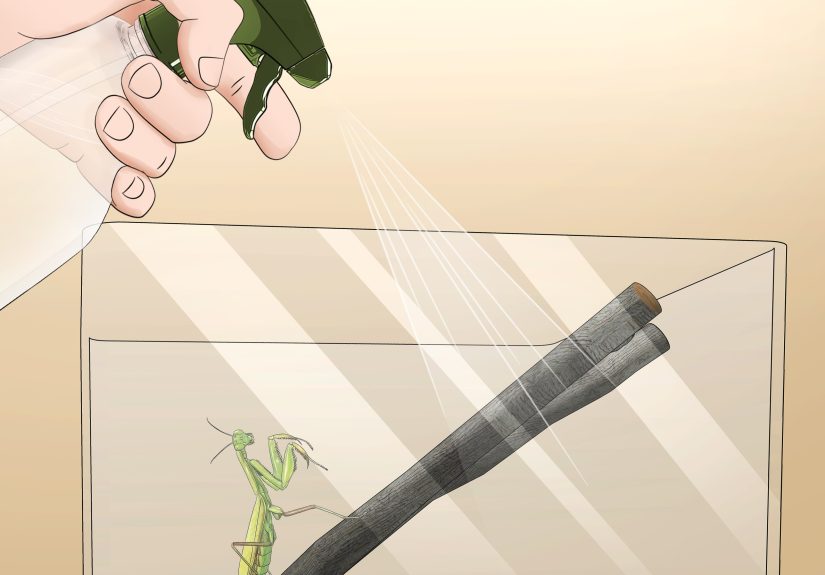
Most mantises drink from water droplets on surfaces. A light mist on the enclosure walls every couple of days often works well, but don’t turn the habitat into a rainstorm. Too much moisture + poor ventilation can encourage mold.
If you use a water dish
Keep it very shallow. Mantises can fall in and drown if it’s too deep. Many keepers skip bowls entirely and rely on misting.
Molting: The Most Important (And Most Fragile) Part of Mantis Care
Mantises grow by moltingshedding their old exoskeleton. This is when things can go wrong if humidity is too low, the enclosure is too cramped, or the mantis can’t get a secure hang.
What a pre-molt mantis looks like
- Less interested in food (sometimes for a day or more).
- More still than usual, often choosing a high perch.
- Hanging upside down can be normalsometimes it’s just “ceiling time,” sometimes it’s molt prep.
What a normal molt involves
A mantis typically finds a secure support, hangs upside down, splits the old exoskeleton, and slowly pulls free. It may hang for a while after the molt as the new exoskeleton hardens. Falling during or immediately after a molt can cause deformities or worseso give it safe height and grip.
Molting rules (the “do not panic” checklist)
- Do not handle a mantis that’s about to molt or has just molted.
- Remove live prey if you suspect pre-molt; feeder insects can disturb or injure a molting mantis.
- Keep humidity appropriate for your species, with good airflow.
- Ensure vertical space so it can fully extend and dry.
Handling a Praying Mantis (Safely, and Without Offending It)
Handling is usually low-risk, but mantises can pinch with their spiny front legs if they feel threatened or think your finger is prey. The safest approach is to let the mantis walk onto you voluntarily.
Best handling method
- Place your hand or a small branch in front of the mantis.
- Gently encourage it to step on (slow movements, no “claw grab” from above).
- Keep handling close to a surface in case it jumps.
- Return it to the enclosure calmlyno sudden shake-offs like you’re dusting flour.
If a child is involved, a great compromise is “stick handling”: let the mantis climb onto a twig so it can be observed without direct contact. It’s safer for the mantis and the human.
Cleaning and Maintenance (Because Even Assassins Make a Mess)
Cleanliness is mostly about preventing mold and removing leftover prey parts. Mantises are tidy groomers, but their food is… not.
Simple routine
- Daily/Every other day: remove dead feeders and leftovers.
- Weekly: wipe visible mess; replace paper towels if used.
- As needed: if you see mold, increase ventilation, reduce misting, and do a full clean/reset.
Egg Cases (Ootheca): What to Do If You Find One
A mantis egg case can hold dozens to hundreds of eggs depending on species and conditions. This is magical… until it hatches indoors and you realize you now supervise a tiny, hungry stampede.
Best practice: leave it where it is (usually)
If the egg case is safe from being crushed or removed, the simplest option is to leave it in place outdoors. If it’s on a doorframe, a busy walkway, or somewhere it will be damaged, relocation is possiblebut there’s risk.
If you must relocate an ootheca
- Use a sharp, thin blade to carefully cut it off without crushing or puncturing the protective outer casing.
- Keep the original orientation (don’t flip it upside down) so hatching isn’t disrupted.
- Attach it to a vertical surface outdoors in a protected location.
Do not hatch it indoors “just to see” unless you’re prepared
Egg cases kept warm indoors can hatch in winter when there’s little food available outside. If you’re trying to overwinter an egg case, guidance from extension resources often recommends keeping it at winter-like temperatures (like an unheated garage or porch), not in a heated living room.
Troubleshooting: Common Problems (And What They Usually Mean)
“My mantis isn’t eating.”
- It may be preparing to molt (common).
- Prey may be the wrong size or type.
- Temperature may be too cool for normal appetite.
- Stress (excess handling, too much activity around the enclosure) can suppress feeding.
“There’s mold in the enclosure.”
- Reduce misting frequency/amount.
- Increase ventilation.
- Remove damp substrate and replace with clean, dry materials.
“My mantis fell during a molt.”
This can be serious. If it’s stuck mid-molt, intervention is risky and best left to experienced keepers or reputable invertebrate communities. Prevention is the real solution: proper humidity, secure grip surfaces, and enough vertical room.
“Should I keep two mantises together?”
In most cases: no. Mantises are often cannibalistic, especially when young or when food is limited. Even adults may attack each other. If you want two mantises, give them two separate homes and let them be neighbors, not roommates.
Are Praying Mantises “Good” for the Garden?
They’re fascinating predators, but they’re also generalistsmeaning they eat pests and beneficial insects and pollinators. Some extension and IPM resources point out that their overall pest-control impact is often limited, partly because they’re solitary and not high-density hunters. In other words: enjoy them, don’t expect them to run your entire integrated pest management program.
Conclusion
Taking care of a praying mantis is less like owning a pet and more like hosting a tiny nature documentary in your homeone that occasionally pauses for wardrobe changes (molts) and demands live snacks with intense eye contact.
If you remember just three things, remember these: ventilation (to prevent mold), correct humidity (to support safe molts), and safe molting space (height + grip). Do that, and you’ll dramatically improve your odds of raising a healthy, thriving mantis.
Real-World Keeper Experiences (The Stuff Guides Don’t Always Tell You)
First surprise: a mantis will make you question your definition of “normal.” One day it’s a lightning-fast hunter, the next it’s hanging upside down in the exact same spot for 18 hours like a tiny green bat. New keepers often panic“Is it stuck? Is it dead? Is it meditating?”but this can be normal behavior, especially near a molt. The best move is usually to reduce stress: no handling, no tapping the enclosure, and no “just one more photo” flash session like it’s a celebrity on a red carpet.
Second surprise: the pre-molt hunger strike is real, and it’s emotionally confusing. You offer a perfectly respectable fly, and your mantis responds with the vibe of someone being handed a cold sandwich at a fancy restaurant. This is often your cue to remove the feeder insect. Many keepers learn this the hard wayby leaving a cricket in overnight and waking up to a mantis that looks annoyed, stressed, or (worst case) injured. Once you’ve seen a mantis choose “molting focus” over “easy meal,” you start respecting its schedule like it’s your boss.
Third surprise: hydration is stealthy. Mantises don’t always march over to a bowl and sip politely. More often, they drink from droplets like they’re sampling dew from a luxury spa wall. Keepers who mist too heavily sometimes discover the downside: wet enclosures can turn into mold factories when airflow is weak. The “aha” moment for many people is learning that ventilation is what makes misting safe. You can have humidity without swamp conditions, but only if the enclosure breathes.
Fourth surprise: feeding feels like running a tiny restaurant with a picky critic. Some mantises prefer flying prey; others happily take roaches. Some will grab food instantly, while others need you to release the insect and let the hunt unfold. Keepers often notice that changing feeder type can “reset” a finicky appetitealmost like the mantis got bored. Variety also becomes a practical tool: if one feeder culture crashes (it happens), you don’t suddenly have a predator on a hunger strike because your one approved menu item is gone.
Fifth surprise: escape attempts are not personal, but they do feel personal. Mantises can be surprisingly determined climbers. People often describe the first “enclosure breach” like a movie scene: you open the lid for two seconds, and your mantis teleports to your sleeve. The lesson most keepers learn is to move slowly, open the enclosure in a clear area, and keep a “transfer stick” handy. Encouraging a mantis onto a branch is easier (and safer) than trying to “catch” it with your hands. Also, chasing a mantis across a living room is an excellent way to discover how many things can be knocked over by a human moving at panic speed.
Final surprise: egg cases are equal parts wonder and chaos. People find an ootheca and imagine one mantis. Then it hatches and they meet the concept of “dozens to hundreds.” The first few minutes are magicaltiny nymphs spilling out like animated punctuation marks. Then reality hits: they’re hungry, they’re cannibalistic, and raising them all is a full-time job you did not apply for. Many keepers end up enjoying a brief observation window, then scattering nymphs appropriately outdoors (only where appropriate and responsible), or rehoming them with experienced keepers. It’s one of the most memorable mantis moments, mostly because it forces you to level up your planning skills overnight.