Table of Contents >> Show >> Hide
- Quick Triage: A 3-Minute Wilt Detective Checklist
- Reason #1: Underwatering or Inconsistent Watering (Drought Stress)
- Reason #2: Overwatering or Poor Drainage (“Wet Feet” and Suffocating Roots)
- Reason #3: Heat Stress and Wind (The “It’s Noon, Leave Me Alone” Wilt)
- Reason #4: Root Problems (Transplant Shock, Root-Bound Plants, or Root-Knot Nematodes)
- Reason #5: The Plant’s Plumbing Is Blocked (Wilt Diseases and Juglone Toxicity)
- When to Remove the Plant (and Not Feel Bad About It)
- Real-World Experiences: What Gardeners Commonly Learn the Hard Way (500+ Words)
Tomato plants are dramatic. One minute they’re standing tall like they’re auditioning for a seed catalog, and the next they’re slumped over like they just
read the news. The tricky part: “wilting” can mean anything from “it’s noon and I’m hot” to “my roots are in trouble” to “something just clogged my
plant plumbing.”
This guide breaks down the five most common reasons tomato plants wilt, plus simple, specific fixes you can do today. We’ll also cover how to diagnose
what’s actually happeningbecause the best tomato care is less about panic-watering and more about detective work (preferably with a trowel and a sense of
humor).
Quick Triage: A 3-Minute Wilt Detective Checklist
Before you do anything else, use this fast checklist to avoid the classic gardening mistake: treating every wilt like it’s drought.
- Check the timing. Is it wilting only in the hottest part of the day and perking up in the evening or early morning? That often points to
heat stress rather than a fatal problem. - Check soil moisture 2–3 inches down. Dry down there? Likely underwatering or inconsistent watering. Wet/soggy? Think overwatering, poor
drainage, or damaged roots. - Look at the lower leaves. Yellowing starting low + wilting can suggest certain wilt diseases (not always, but it’s a clue).
- Inspect the stem at the soil line. Any lesions, mushiness, or collapse? That’s a red flag for disease or rot.
- Scan for pests. Missing leaves, black/green droppings, or chewed stems can cause fast wilting even when soil moisture is fine.
- Think about location. Near a black walnut (or other walnut-family tree)? Tomato wilting can be triggered by juglone toxicity.
Reason #1: Underwatering or Inconsistent Watering (Drought Stress)
Tomatoes like consistency. They don’t need a spa day every afternoon, but they do need steady moistureespecially once they’re flowering and fruiting.
When the root zone dries too much (or swings wildly between bone-dry and soggy), leaves lose pressure, droop, and the plant wilts.
What it looks like
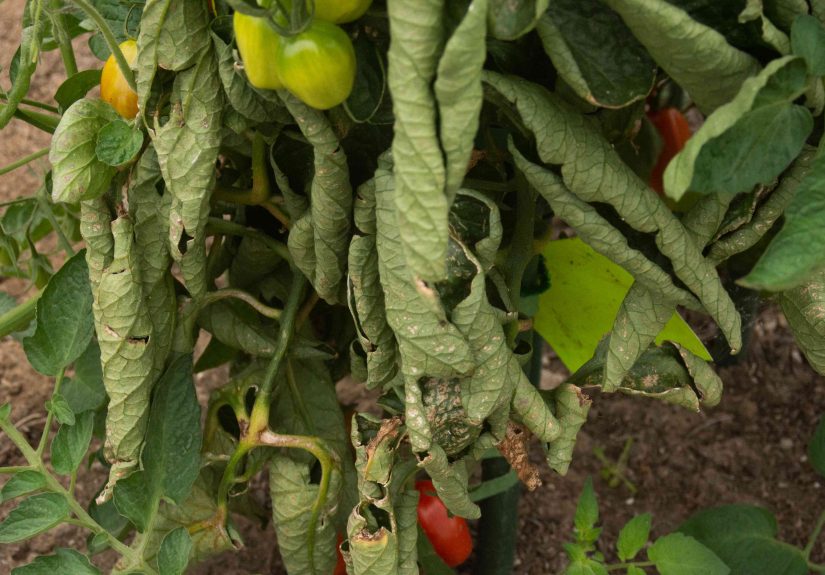
- Leaves wilt and may curl or feel thin/papery.
- Soil is dry a few inches down.
- Plant may perk up after a deep wateringsometimes within hours.
- In containers, wilting can happen fast (pots dry out like they’re on a mission).
How to confirm
Stick your finger or a moisture meter 2–3 inches into the soil near the plant (not right at the stem). If it’s dry down there, you’ve found your suspect.
Also note whether the plant wilts daily during hot weathersome midday droop can be normal, but constant droop plus dry soil is classic drought stress.
How to fix it (today)
- Water deeply and slowly at the base so moisture reaches the full root zone instead of just wetting the surface.
- Water early in the day when possible. It’s more efficient and helps reduce disease risk compared to frequent overhead watering.
- Mulch 2–3 inches (straw, shredded leaves, untreated grass clippings in thin layers) to reduce evaporation and keep roots cooler.
How to prevent repeat wilting
A widely used guideline is aiming for roughly 1–2 inches of water per week (including rainfall), adjusted for heat, wind, soil type, and
whether you’re growing in-ground or in containers. Deep soakings once or twice per week are often better than frequent light splashes, because they
encourage deeper roots and steadier moisture.
Reason #2: Overwatering or Poor Drainage (“Wet Feet” and Suffocating Roots)
Here’s the gardening plot twist: tomatoes can wilt when they get too much water. When soil stays saturated, roots struggle to get oxygen.
Stressed roots can’t pull up water properly, and the plant wilts anywaylike a person standing in a pool wearing winter boots, wondering why walking is hard.
What it looks like
- Wilting even though the soil feels wet.
- Lower leaves yellowing or a generally “sad, heavy” look.
- Soil smells sour or swampy; fungus gnats may appear in containers.
- In severe cases: root rot, stunted growth, and slow recovery after watering changes.
How to confirm
Check moisture a few inches down. If it’s consistently wet day after day, or water pools on the surface, drainage is the issue. In containers, confirm that
water can actually exit the potdecorative cachepots and clogged drain holes are sneaky villains.
How to fix it (today)
- Pause watering until the top couple inches dry out (unless extreme heat demands a small, careful drink).
- Improve drainage: loosen compacted soil gently, avoid crusting, and ensure containers have open drain holes.
- Move containers out of constant rain or reduce saucer water buildup (roots do not enjoy soaking like tea bags).
- Consider raised beds or mounding soil if your garden holds watertomatoes prefer well-drained conditions.
Prevention tips that actually work
- Water only when the root zone needs it, not because the calendar says “Tuesday.”
- Use drip irrigation or a soaker hose to deliver steady moisture without flooding.
- In heavy clay, prioritize soil structure: compost over time, avoid working soil when it’s wet, and consider raised beds.
Reason #3: Heat Stress and Wind (The “It’s Noon, Leave Me Alone” Wilt)
Tomatoes lose water through their leaves all day. When temperatures spike and wind speeds up evaporation, the plant can temporarily lose water faster than
roots can replace it. The result: midday wilting that often improves as the day cools.
What it looks like
- Wilting shows up during the hottest part of the day.
- Plant looks better in the evening or early morning.
- Leaves may roll or curl upward during summer heat without harming yield.
- Flowers may drop during prolonged heat; fruit set can slow when nights stay warm.
How to confirm
If the plant looks fine at breakfast but collapses by lunchand then recovers by dinnerheat/wind is likely the main driver. Confirm soil moisture: heat
stress can happen even when soil is reasonably moist.
How to fix it (today)
- Water early so the plant starts the day with a full “tank.” Avoid frequent midday sprinkles that don’t reach roots.
- Mulch to reduce soil temperature and evaporation.
- Add temporary shade during heat waves (shade cloth, an old sheer curtain, or a lightweight row cover set up so it doesn’t touch foliage).
- Block wind with a fence, trellis, or strategic placement of taller plants nearby.
What not to do
- Don’t drown the plant “just in case.” If the soil is already wet, overwatering adds a second problem.
- Don’t prune heavily during extreme heat. Less leaf area can mean less shade for fruit and more stress.
Reason #4: Root Problems (Transplant Shock, Root-Bound Plants, or Root-Knot Nematodes)
Your tomato’s roots are its entire logistics departmentwater delivery, nutrient shipping, and emergency response. When roots are disturbed, cramped, or
attacked, wilting can show up fast and stubbornly.
Scenario A: Transplant shock
Newly planted tomatoes often wilt for a few days after transplanting. Roots were disturbed, the plant is adjusting to stronger sun and wind, and it can’t
uptake water efficiently yet.
- Fix: Water thoroughly after planting, keep soil evenly moist (not soggy), and offer temporary shade for 2–3 days.
- Prevention: Harden off seedlings gradually before planting outdoors, and transplant during cooler parts of the day when possible.
Scenario B: Root-bound or cramped roots (common in containers)
A tomato in a too-small pot can wilt quickly because the root mass dries out fast and has limited access to moisture.
- Fix: Move to a larger container with drainage, or plant in-ground. Water deeply and mulch the surface of the pot.
- Prevention: Use an adequately sized container for the variety and avoid letting pots bake on reflective surfaces.
Scenario C: Root-knot nematodes (the underground pickpockets)
Root-knot nematodes are microscopic pests that damage roots, causing characteristic galls (swellings). Above ground, plants may look stunted, pale, and
wilt easilyeven when soil moisture seems adequate.
- How to confirm: If you pull a struggling plant and see bumpy, swollen roots, nematodes are likely involved.
- Fix (in-season): Support the plant with consistent watering and mulch. In severe cases, removing the plant may be the best option.
- Prevention: Rotate crops, use resistant varieties labeled with N (nematode resistance), and consider soil
solarization in hot climates.
Reason #5: The Plant’s Plumbing Is Blocked (Wilt Diseases and Juglone Toxicity)
When a tomato wilts despite “perfect” watering, the problem may be inside the stem. Several wilt diseases clog the vascular system (the water-conducting
tissue), and one non-disease culpritjuglone from walnut-family treescan trigger an abrupt collapse too.
Clue #1: Fusarium wilt
Fusarium often begins with yellowing of older leaves and can show a one-sided pattern (one side of a plant, branch, or even leaflets).
Wilting may start as “daytime only” but becomes permanent as the disease progresses. If you split or scrape the stem, you may see browning in the vascular
tissue near the outer stem.
- Fix: There is no reliable cure in a home garden once a plant is infected. Remove and discard infected plants.
- Prevention: Choose resistant varieties labeled with F (and sometimes numbered for races), rotate crops, and keep tools clean.
Clue #2: Verticillium wilt
Verticillium symptoms can resemble Fusarium, often affecting older leaves first with yellowing and wilting. It tends to be associated with cooler
temperatures compared with Fusarium. Stem tissue can show vascular discoloration similar to Fusarium, and lab testing may be needed to distinguish them.
- Fix: Remove severely affected plants; focus on prevention for future seasons.
- Prevention: Plant varieties labeled V (Verticillium resistance) and rotate away from tomatoes for multiple years when possible.
Clue #3: Bacterial wilt (rapid and ruthless)
Bacterial wilt can cause sudden wilting and collapse, sometimes without the gradual yellowing you’d expect. A helpful field test is the “streaming test”:
cut a fresh stem section and place it in watermilky/whitish strands streaming from the cut end can indicate bacterial wilt.
- Fix: Unfortunately, there’s no practical cure once confirmed. Remove and destroy the plant; don’t compost it.
- Prevention: Rotate crops, avoid moving contaminated soil, and consider resistant varieties where available.
Clue #4: Walnut “wilt” (juglone toxicity)
If your tomatoes are growing near a black walnut (or related walnut-family tree), a chemical called juglone can cause abrupt wilting,
stunting, and declineoften showing up in early to mid-summer. The symptoms can resemble wilt diseases, but the consistent clue is proximity to the tree.
- Fix: Move tomatoes to a container location away from the tree’s root zone or grow elsewhere.
- Prevention: Avoid planting tomatoes near juglone-producing trees; even after tree removal, effects can persist for a time.
When to Remove the Plant (and Not Feel Bad About It)
If you confirm bacterial wilt, Fusarium/Verticillium wilt, or severe root-knot nematode damage, removal is often the most practical choice. This isn’t
“giving up”it’s protecting the rest of your garden and setting yourself up for a better next season. If you’re unsure, consider contacting a local
Cooperative Extension office or plant diagnostic lab for confirmation.
Real-World Experiences: What Gardeners Commonly Learn the Hard Way (500+ Words)
The fastest way to understand tomato wilting is to watch how it plays out in real gardensbecause “wilt” is less a diagnosis and more a tomato’s way of
saying, “Something is off, and I’d like to file a complaint.”
Experience #1: The Weekend Warrior Watering Trap
A common story goes like this: a gardener is busy during the week, so the tomatoes get light watering “when remembered.” Then Saturday arrives, guilt kicks
in, and the plants get a full-on deluge. The tomatoes briefly look better, but a few days later the leaves droop again. What’s happening is a moisture
roller coasterdry, then flooded, then drystressing roots and confusing the plant’s ability to regulate water. The fix is boring but effective: set up a
drip line or soaker hose, mulch heavily, and water based on soil moisture a few inches down. Once moisture stays consistent, plants often stop acting like
they’re auditioning for a soap opera.
Experience #2: The Container That Turned Into a Bog
Another classic is the “pretty pot problem.” The tomato is planted in a gorgeous container… that sits inside a decorative outer pot with no drainage. Water
collects at the bottom, roots lose oxygen, and the plant wilts even though the soil looks damp. Gardeners often respond by watering more (because wilt!),
which completes the swamp transformation. The turnaround usually happens when the plant is moved to a pot with real drainage and allowed to dry slightly
between deep waterings. Even without repotting, simply removing the inner pot from standing water and checking drain holes can bring a surprisingly quick
improvement.
Experience #3: The Heat Wave That Looked Like Instant Death
During a hot spell, tomatoes may wilt hard at midday, then recover as the sun drops. Gardeners sometimes interpret this as “my plant is dying,” when it may
be heat stress plus fast transpiration. The best “real life” fix is a combination approach: water early, mulch, and add temporary shade for a few days.
Many gardeners report that even simple shade cloth or a lightweight cover during the worst afternoon hours reduces wilting dramatically. The surprising
lesson: your tomato might not need more waterit might need a break from feeling like it lives on the surface of the sun.
Experience #4: The Mystery Wilt That Turned Out to Be Underground
Some gardeners do everything “right” and still get a tomato that stays stunted, pale, and wilts easily even after watering. When the plant is pulled, the
roots reveal swollen gallsroot-knot nematodes. This is often the moment gardeners realize the most important plant part is the one you rarely see. The
practical takeaway is prevention: crop rotation, resistant varieties (often labeled with an “N”), and avoiding repeatedly planting tomatoes in the same
spot. In mild cases, gardeners sometimes coax a harvest by mulching and keeping moisture steady, but severe infestations usually mean cutting losses and
improving the plan for next season.
Experience #5: The Tomato That Lost a Fight With a Tree
A less commonbut very realexperience is tomato wilting near a black walnut tree. Gardeners describe a sudden slump in early to mid-summer, and no amount
of watering fixes it. Once they move the crop to containers far from the tree’s root zone, the problem disappears in later plantings. The lesson is a
weird-but-useful one: sometimes the “disease” isn’t a pathogen at all. It’s plant chemistry. And your tomato never stood a chance against a tree that’s
been doing chemical warfare since before your garden hose was invented.