Table of Contents >> Show >> Hide
- What Is the Perimeter of a Square?
- Quick Formula Cheat Sheet
- Way 1: Add All Four Sides (The Classic Method)
- Way 2: Multiply One Side by 4 (The Fastest Method)
- Way 3: Use the Area to Find the Side First
- Way 4: Use the Diagonal (or Coordinates) to Work Back to the Perimeter
- How to Choose the Right Method
- Common Mistakes to Avoid
- Practice Problems (With Answers)
- Conclusion
- Experience-Based Notes and Real-Life Scenarios (Extended)
Squares are the overachievers of geometry: all four sides match, all four angles are right angles, and the formulas are wonderfully tidy. If you’ve ever needed to measure fence length for a square garden bed, trim for a picture frame, or border tape for a classroom poster, you’ve already met the perimeter of a square in real life.
In this guide, you’ll learn 4 ways to calculate the perimeter of a square, from the basic “add all the sides” method to smarter options when you only know the area or the diagonal. We’ll also cover common mistakes, practical examples, and a few “why did my answer look weird?” moments that happen to everyone (yes, even the people who own graph paper in bulk).
What Is the Perimeter of a Square?
The perimeter is the total distance around the outside of a shape. For a square, that means adding the lengths of all four sides. Because all sides of a square are equal, perimeter problems are usually quicker than they look.
A square’s perimeter is measured in linear units such as inches, feet, meters, or centimeters. That matters because area is measured in square units (like cm2 or ft2), and mixing those up is one of the most common mistakes.
Quick Formula Cheat Sheet
- If the side length is known:
P = 4s - If the area is known:
P = 4√A - If the diagonal is known:
P = 2√2d - If coordinates are known: find one side with the distance formula, then multiply by 4
Where:
P= perimeters= side lengthA= aread= diagonal length
Way 1: Add All Four Sides (The Classic Method)
This is the most straightforward method, and it’s perfect for beginners. Since a square has four equal sides, you can write:
P = s + s + s + s
This method is great when you want to see what perimeter really means: the total distance around the boundary. It also helps when teaching younger students or checking your work before using a shortcut formula.
Example
Suppose each side of a square is 8 cm.
P = 8 + 8 + 8 + 8 = 32 cm
So, the perimeter is 32 cm.
When to Use This Method
- When you’re first learning perimeter
- When you want a simple check before using a formula
- When side lengths are shown visually on a diagram
Way 2: Multiply One Side by 4 (The Fastest Method)
Once you remember that all four sides of a square are equal, you can use the shortcut:
P = 4s
This is the most commonly used formula for the perimeter of a square, and for good reason: it’s fast, clean, and hard to mess up (unless you accidentally multiply by 3 because your coffee hasn’t kicked in yet).
Example
A square tile has a side length of 11.5 feet.
P = 4 × 11.5 = 46 feet
The perimeter is 46 feet.
Pro Tip
If your calculator gives a decimal, keep the unit attached to the final answer. Write 46 ft, not just 46. Geometry answers without units are like recipes without oven temperatures: technically present, but not very helpful.
Way 3: Use the Area to Find the Side First
Sometimes you don’t know the side length, but you do know the area of the square. No problem. Start with the area formula:
A = s²
Solve for the side length:
s = √A
Then plug that into the perimeter formula:
P = 4s = 4√A
Example
A square patio has an area of 196 ft². Find its perimeter.
- Find the side length:
s = √196 = 14 ft - Find the perimeter:
P = 4 × 14 = 56 ft
The perimeter is 56 feet.
Why This Method Matters
Real-world problems often give area (for flooring, paint coverage, land use, or tile planning) instead of side length. Knowing how to move from area to side to perimeter makes you more flexibleand much less likely to stare dramatically at a worksheet.
Way 4: Use the Diagonal (or Coordinates) to Work Back to the Perimeter
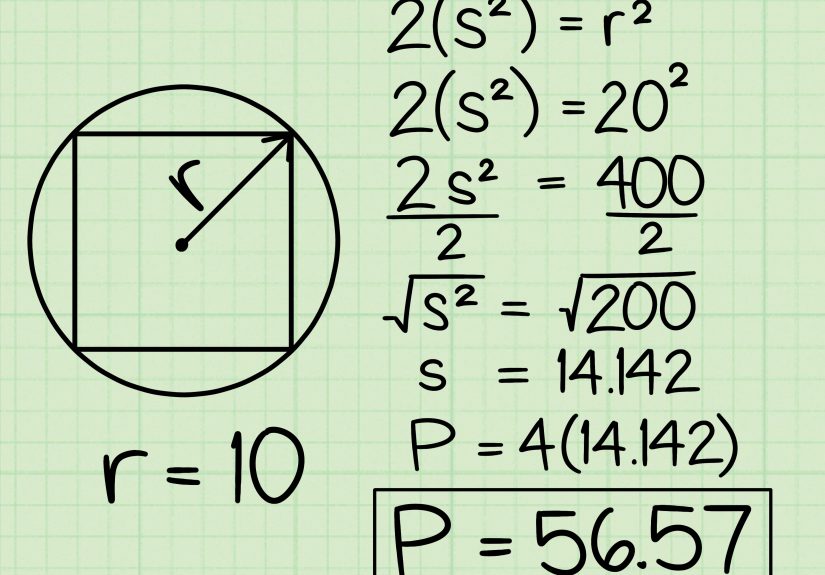
This is the “geometry ninja” method. If you know the diagonal of a square instead of the side length, you can still find the perimeter using the relationship between the side and diagonal.
In a square, the diagonal creates two congruent right triangles, so:
d = s√2
Solve for s:
s = d/√2
Then substitute into P = 4s:
P = 4(d/√2) = 2√2d
Example Using a Diagonal
A square has a diagonal of 9√2 inches. Find the perimeter.
- Find the side:
s = (9√2)/√2 = 9 inches - Find the perimeter:
P = 4 × 9 = 36 inches
The perimeter is 36 inches.
Coordinate Grid Twist (Bonus Within Way 4)
If a problem gives you coordinates for two adjacent vertices of a square, first find the side length using the distance formula:
s = √[(x₂ - x₁)² + (y₂ - y₁)²]
Then use P = 4s.
Example: Adjacent vertices are (2, 3) and (7, 8).
s = √[(7 - 2)² + (8 - 3)²] = √[5² + 5²] = √[25 + 25] = √50 = 5√2
P = 4(5√2) = 20√2 ≈ 28.28 units
This is especially useful in coordinate geometry, algebra, and standardized test problems where the square is tilted and no side length is labeled.
How to Choose the Right Method
Here’s the fastest way to decide:
- Side length given? Use
P = 4s - All side lengths listed? Add them (Way 1) or confirm they match and use
4s - Area given? Use
P = 4√A - Diagonal given? Use
P = 2√2d - Coordinates given? Use distance formula, then multiply by 4
In short: don’t force every problem into the same formula. Geometry gets much easier when you identify what information you already have.
Common Mistakes to Avoid
1) Confusing Perimeter and Area
Perimeter is the distance around the square. Area is the space inside the square. If your final answer says 48 cm² for a perimeter problem, your units just tattled on you.
2) Using the Diagonal as If It Were a Side
If the diagonal is given, don’t use P = 4d. The diagonal is longer than the side. Use the square relationship d = s√2 first.
3) Forgetting Units
Always include units in the final answer: inches, feet, centimeters, meters, etc. If the problem starts with inches, don’t quietly end in feet unless you convert.
4) Rounding Too Early
If you’re working with square roots (like √50), keep the exact form as long as possible, then round at the end. Early rounding can make your final perimeter slightly off.
Practice Problems (With Answers)
Practice 1
A square picture frame has a side length of 12 in. What is the perimeter?
Answer: P = 4 × 12 = 48 in
Practice 2
A square garden plot has an area of 81 yd². What is the perimeter?
Answer: s = √81 = 9 yd, so P = 4 × 9 = 36 yd
Practice 3
A square has a diagonal of 6√2 cm. What is the perimeter?
Answer: s = (6√2)/√2 = 6 cm, so P = 4 × 6 = 24 cm
Practice 4
Adjacent vertices of a square are (1, 1) and (4, 5). Find the perimeter.
Answer: s = √[(4-1)² + (5-1)²] = √[3² + 4²] = √25 = 5, so P = 20 units
Conclusion
Learning 4 ways to calculate the perimeter of a square gives you more than a formulait gives you options. The simple methods (adding sides or using P = 4s) are perfect for quick problems, while the area, diagonal, and coordinate-based methods help you solve more advanced geometry questions without guessing.
The key is to match the method to the information you’re given. If you know the side length, use the shortcut. If you know area or diagonal, convert first. And if the square is hiding inside a coordinate grid, let the distance formula do the heavy lifting. Geometry looks a lot less scary when you realize it’s mostly a game of “what do I know, and what can I find next?”
Experience-Based Notes and Real-Life Scenarios (Extended)
One of the most common experiences people have with square perimeter shows up in DIY projects. Imagine someone building a small raised garden bed that is perfectly square. They know each side is 4 feet, so they assume they need “about 16 feet” of edging. That instinct is rightbut the useful lesson comes when they actually shop for materials. Edging often comes in fixed lengths, like 6-foot or 8-foot pieces. Suddenly, a simple perimeter calculation becomes a practical planning tool: a 16-foot perimeter might require three 6-foot strips (18 feet total), not two. This kind of experience helps people understand that perimeter is more than a classroom number; it directly affects cost, waste, and how many materials to buy.
Another common learning moment happens in classrooms when students confuse area and perimeter while working with square tiles. A student may look at a 5-by-5 square and say, “The perimeter is 25,” because they multiplied the side lengths the way they would for area. Teachers often fix this with a hands-on approach: trace the outside edge with a finger, string, or marker. Once students physically move around the boundary, the idea clicks. They begin to see that perimeter is the outside path, while area is the inside coverage. That experience sticks because it’s visual and physical. It turns an abstract formula into something you can literally walk around.
People also run into perimeter calculations during decorating projects, especially when adding trim, border wallpaper, LED strips, or ribbon around square objects. A person might measure only one side of a square mirror frame and forget to multiply by four, then come home short on trim. After doing that once, they almost never forget again. In many home projects, the perimeter answer also needs unit conversion. For example, a square table top might measure 22 inches per side, giving a perimeter of 88 inches. But if trim is sold by the yard, the shopper must convert 88 inches into yards before buying. These experiences teach an important habit: calculate carefully, then match your units to the material sold.
Test-taking brings a different kind of experience. On quizzes and standardized tests, square perimeter problems are often disguised. Instead of giving the side length directly, the problem may provide the area, a diagonal, or two coordinate points. Students who memorize only P = 4s sometimes freeze because they don’t see s right away. But students who practice multiple methods recognize the setup: “Oh, I can get the side from the area,” or “That diagonal means I need the square root relationship.” The experience here is less about arithmetic and more about pattern recognition. Over time, learners become faster not because the math changes, but because they learn to identify the hidden path to the side length.
Finally, there’s a valuable real-world experience in estimation. Before doing exact math, people often estimate the perimeter to check whether their final answer makes sense. If a square has a side close to 10 units, the perimeter should be close to 40 units. If the final answer comes out as 400 or 4, that’s a red flag. This estimate-first habit is especially helpful when square roots and decimals appear, such as coordinate or diagonal problems. It helps catch calculator slips, input mistakes, and misplaced decimals. In other words, experience with perimeter is not just about learning one formulait’s about building good mathematical judgment. And that judgment is what makes geometry useful long after the worksheet is gone.